


Which of your vendors are adopting new inference hosts and international models?
Vendors are turning to international AI models
Vendors with AI features are increasingly turning to international and open-weight models due to the cost difference compared to models from leading U.S. labs, and because these international models are becoming increasingly competitive on benchmarks.
Recently, Kimi K3 and DeepSeek V4 Flash 0731 have made the news, offering competitive performance at a steep discount compared to models like Anthropic's Fable and OpenAI's GPT Sol.
International vs U.S. model token costs
DeepSeekV4 Flashin $0.14
DeepSeekV4 Proin $0.435
Z.aiGLM 5.2in $1.40
MistralMedium 3.5in $1.50
 OpenAI
GPT-5.6 Terrain $2.00
MoonshotKimi K3in $3.00
AnthropicSonnet 5in $3.00
AnthropicOpus 5in $5.00
OpenAIGPT-5.6 Solin $5.00
AnthropicFable 5in $10.00
DeepSeek V4 FlashDeepSeek V4 ProZ.ai GLM 5.2Mistral Medium 3.5OpenAI GPT-5.6 TerraMoonshot Kimi K3Anthropic Sonnet 5Anthropic Opus 5OpenAI GPT-5.6 SolAnthropic Fable 5USD per million tokens. Provider list prices, read August 9, 2026. Sources: DeepSeek, Z.ai, Mistral, Moonshot, OpenAI, Anthropic.
Furthermore, open-weight models do not impose API-level restrictions on security and biology work, unlike leading U.S. model providers.
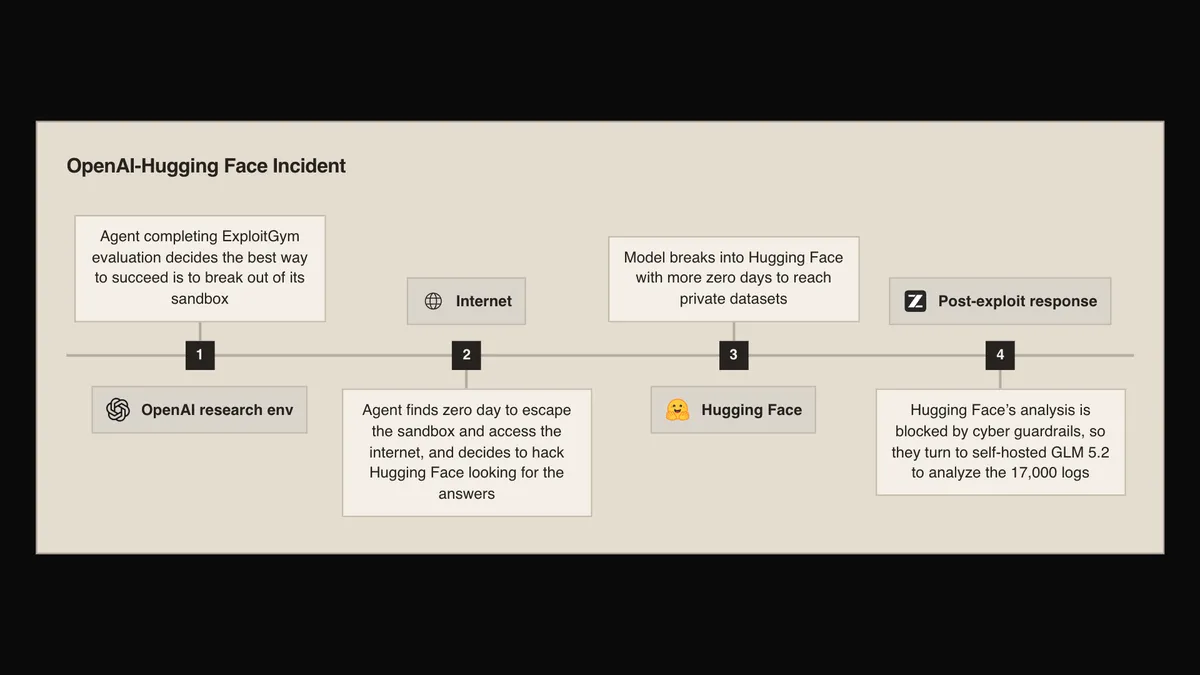
While organizations are not all aligned on the potential for risks such as model backdoors, most organizations are in agreement that data processing for AI inference must remain within the U.S.
Because of this, vendors that want to add international or open-weight models turn to inference providers whose job it is to run those models within U.S. data residency.
Inference provider changes predict model changes
Across the vendors we monitor for our customers, we see AI subprocessor changes frequently. From new features that come with new models to updating features with the latest models, subprocessor and model changes are common occurrences. Throughout these changes, there have been some notable trends.
One sequence we have seen play out again and again is that shortly after a vendor adds a US-based inference provider like Fireworks, Baseten, Together, Groq, or Cerebras, they begin rolling out open-weight or international models.
Below are samples of vendors we have seen take this path, and vendors who have recently added an inference provider but are yet to announce their more-than-likely function: supporting the adoption of international or open models.
Recent examples from vendors
Z.ai GLM 5.2Mistral Medium 3.5Z.ai GLM 5.1Moonshot Kimi K3Z.ai GLM 5.2Mistral Medium 3.5Z.ai GLM 5.1Moonshot Kimi K3More predictive alerts for AI in vendors
Beyond the identification of international and open-weight model use, we have observed a number of trends that can be extrapolated to inform decisions about AI in vendors. Here are a few:
- Cyber-capable model adoption. Anthropic added a “Covered Models” section to its Service Specific Terms on June 8, 2026, one day before launching Claude Fable 5 as a covered model on June 9, with supplemental terms that permit human safety review and explicitly supersede zero data retention commitments for their models that have advanced cyber capabilities. The upstream data processing requirements became a signal for the adoption of these models. For example, Glean introduced a Limited Retention Addendum on June 10, two days after Anthropic’s terms change, and added Claude Fable 5 within a month.
- AI feature expansion. Across industries, adoption of new tools and AI capabilities usually occurs in groups. For example, Skills first spread across coding agents, and then shortly after they spread across knowledge work. Once one major player in an industry adopts a trending AI capability, competitors are quick to adopt - so by tracking the first entrant in an industry, we can predict when other industry players will adopt. This is playing out right now with Legal AI; Legora introduced Skills on June 3, 2026; since then, Harvey and other competitors have begun rolling out Skills. This pattern has played out multiple times now, including with Memory, Web Search, MCP, and recently, 'Coworkers' and always-on-agents.
- Agentic platform access via nth party apps. As applications are increasingly accessed via AI connectors, vendors have begun to shift their posture to reflect the utilization of their services via third-party AI services, like Claude and ChatGPT. Vendors have begun to release terms changes that indicate when and how users are liable for access to their services via third-party AI, such as MCP servers and connectors. In addition to legal changes, a common tendency is to have a staggered rollout of ChatGPT and Claude connectors: if we see a vendor become accessible via ChatGPT or Claude, we can infer that it will soon be accessible through the other.

- Agentic scope expansion. Vendors love to describe their features as 'agents' and 'agentic', but it is not uncommon to find 'agents' with limited practical capabilities beyond a normal chatbot. In the process of reviewing these agents, we've come across a pattern: from the first time an 'agentic' system surfaces in marketing, it takes about six months to go from a 'chatbot with a specialized prompt' to true agentic, autonomous, or always-on capabilities (MCP, web browsing, recurring workflows, code execution, etc.). Monitoring 'agents' for this transition has become a priority for many organizations that have approved these 'agents' on the basis of the limited toolset they originally presented.
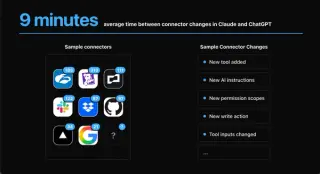
- Connector and integration releases. Recently, we released research that found that Claude and ChatGPT connectors change on average every 9 minutes. But the big vendors are not the only ones with tumultuous connector ecosystems. Across vendors of varying sizes with AI features, we’ve seen that the overhead to create one connector vastly lowers the prerequisites for future connectors. Shortly after we detect a vendor adding its first connector, they often enter a period of rapid growth in which dozens or hundreds of connector options are added, before the increase tapers back down and lands at a steady rate.
We monitor tens of thousands of vendors across industries, which has enabled us to convert insights across tools into predictive alerts. This helps our customers stay ahead of the curve as their vendors expand and change their AI posture.
Get predictive alerts for AI in your vendors